
I've been pondering some ideas for a new blog post. Back in late September I was going to write about the Roman disaster in the Teutoburg Forest which occurred exactly 2000 years ago (in September) and how that marked the end of Roman expansionism even though the Empire would continue to thrive for centuries. Unfortunately, that post will have to wait for the next anniversary.
Since there were a lot of interesting news stories today, I felt that a blog post of miscellany would be appropriate.
Attorney General Eric Holder announced on Friday that once again, America would be a nation ruled by laws. Ten of the detainees at Guantanamo Bay will have their day in court. However, I might be giving the AG and the Obama Administration a little too much praise. True, criminal charges and trials are long overdue and I'm glad to see that the Justice system finally found the WD-40 to get the gears turning. The fact remains that Guantanamo Bay remains an open wound in America's credibility and a rallying cry for Muslim extremists.
Furthermore, I still have doubts that the prisoners at Guantanamo will receive fair trials. Are confessions or evidence given under duress really admissable in a court (military or civilian)? Granted, the current Administration is in a tough situation that they themselves didn't create, but the fact remains that no fair, legal structure exists to deal with this situation. Five of the prisoners mentioned by Mr. Holder will be tried in a civilian court while the others will face a military court. Who determines which prisoner is tried where?
I definitely do not envy what the Administration has on its plate. I won't even touch the issues of the executions likely to result from these trials or the irrational fear of just keeping these prisoners on U.S. soil instead of limbo.
About a month ago, NASA smashed a probe into the south pole of the Moon to see if there was anything interesting (water). Apparently, they found a fair bit of water. This is an interesting discovery, but not terribly surprising and does very little to convince me that the Moon is a prime location for colonization. The fact remains that the Moon is a very dead and unexciting place. The Moon would be a great location for the second human colony or a huge observatory. If NASA/America wants to push manned exploration, Mars remains the most promising destination. It has an atmosphere and liquid water and low gravity which make it far more interesting that the Moon. Propellant can be produced on site and the low gravity makes Mars an ideal hub for human exploration (it's easier to get from Mars to the Moon than from the Earth to the Moon).
Unfortunately, the American space program is having an identity crisis, Russia and Europe are content with low orbit and China is looking for a nationalistic statement with their prospective Moon mission. Meanwhile, the weaponized Ebola and Von Neumann machines are desperate to make us regret not having a backup planet.
This week I started reading a book called "Tides of War" by Steven Pressfield. It's a bit of historical fiction about Alcibiades and the fateful Sicilian Expedition. Naturally, whenever I read it, I am reminded of the Sicilian Expeditions undertaken by the latest Bush Administration and continued by the current Administration. I will be the first to admit that the historical parallels between the Peloponnesian War and today are fairly weak, but the lesson is no less relevant.
Athens was on the rebound during the Peace of Nicias which ended the war against Sparta (low level conflicts continued elsewhere, but they were proxy wars at worst). The depleted treasury began to recover and the plague subsided when Atticans returned to their towns and farms. Then some backwater town in Sicily with loose ties to Athens called for help and a demagogic Athenian named Alcibiades decided to use this as an opportunity to expand the Athenian Empire. Three years, thousands of talents, hundreds of ships and tens of thousands of troops later, the Sicilian Expedition was over and, for all practical purposes, annihilated.
Athens went in with no regional allies, a crooked, hubristic leader and emerged poorer, weaker and at war with Sparta once more. Alcibiades was tried, in absentia during the campaign, for holding sacreligious parties and decided to switch sides. Command of the expedition fell into the hands of one of the few Athenians who opposed Alcibiades adventurism, Nicias. Prior to the beginning of the ill-fated campaign, he pleaded with the Athenian assembly to reconsider. Once Athens was committed, no one thought to call the ships back when things went awry.
Athenians learned the truth about national exceptionalism the hard way. Probably a lesson about the limits to imperial expansion in there, too (Teutoburg Forest is another good one). For the folks averse to "irrelevant" ancient history, the Soviet Union learned this lesson not even 30 years ago in an all too familiar setting.
Showing posts with label Space...the Final Frontier. Show all posts
Showing posts with label Space...the Final Frontier. Show all posts
Friday, November 13, 2009

Thursday, March 5, 2009
Through the Looking Glass
Since my attempt at delivering a semi-accurate prediction of the NHL trade deadline turned out not-so-good, I'm going to move onto something else. Though, the moves made by Pittsburgh and Calgary are hardly unprecedented and are fairly typical for teams in their position. Calgary added some good talent at center and defense where they needed help. Calgary is now in a much stronger position to compete for the Western Conference title. Pittsburgh added the classic NHL rental player, Bill Guerin. Don't get me wrong, he is a great player with good playoff experience, but don't waste $150 on a Guerin sweater if you are a Pittsburgh fan, he'll be gone in 3 years or less.
Now, on to business.
On Friday (tomorrow!), NASA will be launching the Kepler Space Telescope! Its mission is to spend the next three or so years surveying a portion of the cosmos for exoplanets. Kepler will do so by detecting the minute changes in the brightness of stars as planets travel between the star and the observatory. This is some really cool stuff, but I wonder about the effectiveness of this detection method. If I interpret Kepler's functionality correctly, it will only be able to detect exoplanets when they cross directly between the star and the telescope. I can only assume (there are billions of stars out there - statistically, I doubt they are all oriented the same way) that a majority of other solar systems do not have orbital planes that make this kind of observation possible. Nevertheless, I look forward to seeing what Kepler is capable of.
Another cool factoid about Kepler: it will be one of the few spacecraft that do not orbit the Earth. Kepler will be placed in a heliocentric orbit (it orbits the Sun). This orbit allows it to make better observation for some technical reasons that I lack the training and education to fully explain, let alone understand. There's a good explanation of Kepler's orbit here.
Supposedly, NASA will be broadcasting the launch live on the NASA TV network and probably somewhere on their website, too. Keep your fingers crossed!
Now, on to business.
On Friday (tomorrow!), NASA will be launching the Kepler Space Telescope! Its mission is to spend the next three or so years surveying a portion of the cosmos for exoplanets. Kepler will do so by detecting the minute changes in the brightness of stars as planets travel between the star and the observatory. This is some really cool stuff, but I wonder about the effectiveness of this detection method. If I interpret Kepler's functionality correctly, it will only be able to detect exoplanets when they cross directly between the star and the telescope. I can only assume (there are billions of stars out there - statistically, I doubt they are all oriented the same way) that a majority of other solar systems do not have orbital planes that make this kind of observation possible. Nevertheless, I look forward to seeing what Kepler is capable of.
Another cool factoid about Kepler: it will be one of the few spacecraft that do not orbit the Earth. Kepler will be placed in a heliocentric orbit (it orbits the Sun). This orbit allows it to make better observation for some technical reasons that I lack the training and education to fully explain, let alone understand. There's a good explanation of Kepler's orbit here.
Supposedly, NASA will be broadcasting the launch live on the NASA TV network and probably somewhere on their website, too. Keep your fingers crossed!
Monday, December 22, 2008
Change I Can Believe In?
Now, I have been, and continue to be, supportive of President-elect Obama, but the latest bit of news that I have come across has created some doubt for me.
According to Daily Tech, the Obama transition team is looking to scrap the next-generation manned spaceflight booster program. The Ares was being designed to replace the Space Shuttle and has been in development since 2005 (though initial concepts were thrown around as far back as 1995).
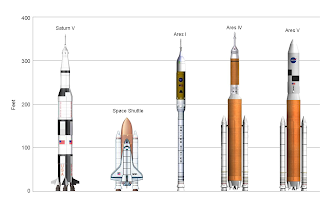
Note: Ares IV development has been discontinued.
Now I realize that the economic crisis and need to cut the federal budget means that money is at a premium, but I must iterate the importance of the space program. Mr. Obama, among others, has talked about investing in the future of America and it's hard to find a better symbol for that future than the manned spaceflight program. I cite the 1960s NASA programs that inspired a generation of young Americans to become scientists, engineers and advocates.
Critics legitimately point-out that the costs of the Ares program are ballooning and that using old heavy-lift rockets such as the Delta or Atlas series would be cheaper. Cost estimates of the Ares program have usually hovered around $3 billion, which is a lot, but nowhere close to other major government aerospace programs of the 21st century. In 2000, four years before the first delivery, a Congressional committee report indicated that the cost of developing the F-22 fighter aircraft would be $14 billion (up nearly a billion from six months earlier). In 2005, the Washington Post reported on the $44.8 billion cost to development of the F-35 strike aircraft (cost was partially mitigated by contributions from other governments). 2006 Department of Defense budget: $527 billion (not counting expensive things like foreign wars); 2006 NASA budget: $15 billion.
The safety of the Delta and Atlas rockets is also a major concern. Right now, these boosters are used to get satellites and probes into space. The benefit of the Ares is the top-to-bottom focus on delivering people into space. Furthermore, Delta and Atlas boosters are not true heavy-lift rockets and would not be able to send astronauts to the moon. If we want to send astronauts to the Moon and beyond, which we should want for a plethora of reasons, we need to rediscover and reinvent the heavy-lift capability of the 1960s. In order to illustrate the heavy-lift question:
Delta IV Heavy: 23,000 kg to Low-Earth Orbit (LEO)
Atlas IIIB: 10,000 kg to LEO
Ares I (shuttle replacement): 25,000 kg to LEO
Space Shuttle: 24,000 kg to LEO
Ares V (heavy-lift): 188,000 kg to LEO/71,000 kg to TLI (Trans-Lunar Injection)
Saturn V: 118,000 kg to LEO/47,000 kg to TLI
As I blather about the manned spaceflight program, the other important things that NASA does, like planet-side research and development, should not be neglected either. As the Daily Tech article noted, during the campaign, Mr. Obama was inconsistent in his plans for NASA. Fortunately, Mr. Obama has nominated some very smart people for science and educational roles. Hopefully, they can keep the next administration from neglecting science, research, technology, and the future.
According to Daily Tech, the Obama transition team is looking to scrap the next-generation manned spaceflight booster program. The Ares was being designed to replace the Space Shuttle and has been in development since 2005 (though initial concepts were thrown around as far back as 1995).

Note: Ares IV development has been discontinued.
Now I realize that the economic crisis and need to cut the federal budget means that money is at a premium, but I must iterate the importance of the space program. Mr. Obama, among others, has talked about investing in the future of America and it's hard to find a better symbol for that future than the manned spaceflight program. I cite the 1960s NASA programs that inspired a generation of young Americans to become scientists, engineers and advocates.
Critics legitimately point-out that the costs of the Ares program are ballooning and that using old heavy-lift rockets such as the Delta or Atlas series would be cheaper. Cost estimates of the Ares program have usually hovered around $3 billion, which is a lot, but nowhere close to other major government aerospace programs of the 21st century. In 2000, four years before the first delivery, a Congressional committee report indicated that the cost of developing the F-22 fighter aircraft would be $14 billion (up nearly a billion from six months earlier). In 2005, the Washington Post reported on the $44.8 billion cost to development of the F-35 strike aircraft (cost was partially mitigated by contributions from other governments). 2006 Department of Defense budget: $527 billion (not counting expensive things like foreign wars); 2006 NASA budget: $15 billion.
The safety of the Delta and Atlas rockets is also a major concern. Right now, these boosters are used to get satellites and probes into space. The benefit of the Ares is the top-to-bottom focus on delivering people into space. Furthermore, Delta and Atlas boosters are not true heavy-lift rockets and would not be able to send astronauts to the moon. If we want to send astronauts to the Moon and beyond, which we should want for a plethora of reasons, we need to rediscover and reinvent the heavy-lift capability of the 1960s. In order to illustrate the heavy-lift question:
Delta IV Heavy: 23,000 kg to Low-Earth Orbit (LEO)
Atlas IIIB: 10,000 kg to LEO
Ares I (shuttle replacement): 25,000 kg to LEO
Space Shuttle: 24,000 kg to LEO
Ares V (heavy-lift): 188,000 kg to LEO/71,000 kg to TLI (Trans-Lunar Injection)
Saturn V: 118,000 kg to LEO/47,000 kg to TLI
As I blather about the manned spaceflight program, the other important things that NASA does, like planet-side research and development, should not be neglected either. As the Daily Tech article noted, during the campaign, Mr. Obama was inconsistent in his plans for NASA. Fortunately, Mr. Obama has nominated some very smart people for science and educational roles. Hopefully, they can keep the next administration from neglecting science, research, technology, and the future.
Subscribe to:
Posts (Atom)